
Global demand for efficient lighting is reshaping commercial, retail, hospitality, and residential projects. The International Energy Agency’s Energy Efficiency 2023 report estimates that lighting consumes nearly 15% of global electricity. That figure makes product selection more important than appearance alone.
This guide examines Spotlight LED Lights through practical buying criteria. These include beam angle, lumen output, color rendering, flicker performance, heat control, driver compatibility, and service life. A narrow 15-degree beam can sharpen a museum display. A 36-degree beam may suit a clothing store better. Small choices matter.
The U.S. Department of Energy’s solid-state lighting research reports continue to identify efficacy, optical control, color quality, and thermal management as major development priorities. Roland Haitz, a respected LED technology pioneer, predicted, “The cost per lumen of an LED will fall by a factor of 10, while the amount of light generated will increase by a factor of 20, for every decade.” His observation explains the industry’s rapid progress, but it does not make every product reliable.
Some market comparisons remain incomplete. Advertised wattage may hide weak optics, unstable drivers, or poor heat dissipation. Buyers should inspect test reports, warranty terms, photometric files, and regional certification requirements. CE, UKCA, UL, or other approvals may apply differently across markets. IP ratings also need context; IP65 does not automatically guarantee suitability for every outdoor installation.
The best Spotlight LED Lights balance visual comfort, verified performance, installation conditions, and long-term operating cost. Brightness alone is not enough. A careful buyer still needs to question the numbers.
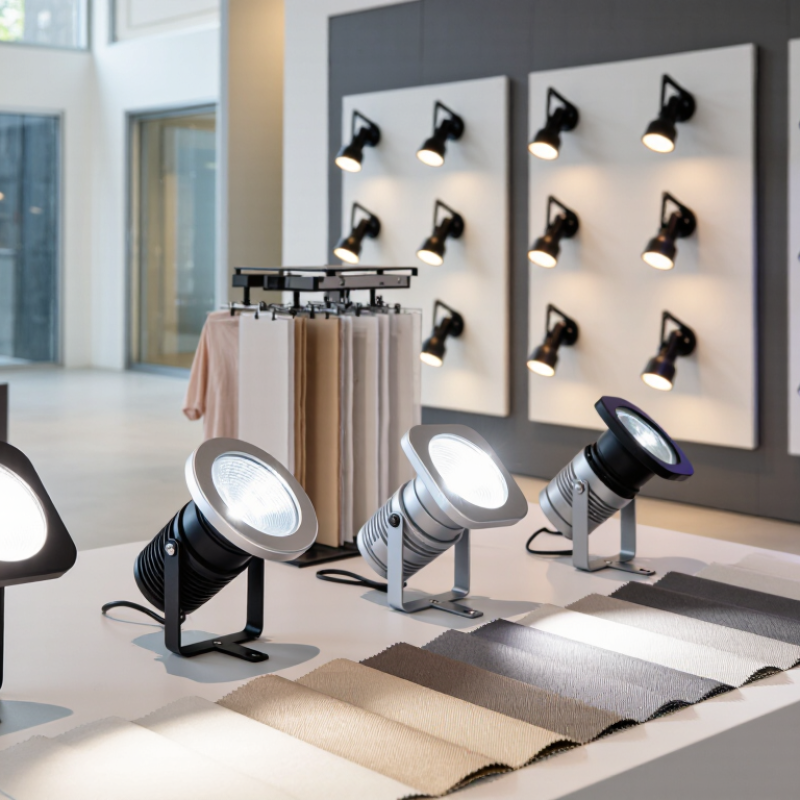
Spotlight LED performance depends on more than a bright beam. An efficacy of 80–150 lumens per watt offers a useful comparison point: higher values can deliver more light for the same electrical input. Yet the upper end is not automatically best. Beam angle, color quality, housing temperature, and dimming behavior all affect real-world results. Check tested specifications under stated operating conditions, not just a headline figure.
A 50,000-hour life rating can indicate long service, but it is not a promise that every component will last that long. Heat buildup around the driver or LED board may shorten performance. In a shop, inspect how the fixture handles warmth after several hours, and ask whether the rating describes lumen maintenance or complete product life. Small details matter.
Tips: Compare efficacy, beam angle, and color rendering together. Keep ventilation clear, and record operating hours during a trial. If the light looks harsh on a sample surface, reconsider the beam or color temperature. Specs help, but they do not replace a practical test.
Top Spotlight LED Lights for Global Buyers
Selecting spotlight LED lights for global applications means matching beam angle, CCT, and CRI to the task. A 15-degree beam creates a tight pool of light for a display or architectural detail. A 36-degree beam spreads illumination across a wider surface, such as a shop shelf. Check the fixture’s photometric data and test its placement; room finishes and mounting height can change the result.
CCT affects how a space feels. Warm white around 3000K can make wood and hospitality interiors feel inviting, while 4000K often suits work areas that need a cleaner appearance. CRI 80+ is a practical baseline for many general applications, but it may not render delicate product colors accurately. For textiles, food, or artwork, compare samples under the actual light before specifying.
Tips: Confirm beam angle, CCT, and CRI on the same product data sheet. Use a mock-up to spot glare, uneven coverage, or colors that look unexpectedly dull. A spec can look right on paper and still disappoint in the room.
Before importing spotlight LED lights, verify what an IP65 claim actually covers. IEC 60529 defines IP ratings for protection against dust and water ingress. IP65 means dust-tight and protected against water jets, not immersion. Ask for the test report, including the tested fixture configuration and cable entries. A sealed front lens means little if a rear gland leaks.
Small details matter.
Thermal design deserves equal scrutiny. The U.S. Department of Energy’s LED Systems Reliability Consortium identifies heat management as a key factor affecting LED system reliability. Request operating-temperature data and inspect the heat path from LED board to housing. A compact aluminum body may look sturdy, yet perform poorly when installed in a hot, enclosed ceiling.
Measure, don’t guess.
For light-maintenance claims, request LM-80 test data for the LED package, array, or module used in the product. The Illuminating Engineering Society’s LM-80 method measures lumen and color maintenance over time; it does not test the entire spotlight. DOE guidance describes TM-21 as a method for projecting long-term maintenance from LM-80 results. Check that the reported test conditions match your intended use.
Paperwork can still leave gaps.
Compare the tested current and temperature with the fixture’s actual operating conditions, and ask for clarification when they differ.
Top Spotlight LED Lights for Global Buyers
International projects demand more than a bright beam. A spotlight may perform well in a showroom yet flicker on a dimmer at a hotel site. Check the dimming method, driver compatibility, and low-end stability together. Ask for test results using the dimmer models planned for installation. A smooth fade matters.
Voltage is another practical checkpoint. Confirm the product’s rated input range and frequency against the destination supply, then verify this on the driver label and technical sheet. For a mixed-voltage project, test samples under realistic conditions before placing a large order. Small differences in wiring or control setup can change the result. Paperwork alone is not enough.
IEC compliance claims should name the applicable standard and product configuration. Request current test reports from a qualified laboratory, and confirm that they match the exact model, driver, and accessories being purchased. This step can feel slow. It is still cheaper than discovering a mismatch after fixtures are installed. Keep records with the project file, and review any assumptions that were not independently checked.
| Market | Typical Mains Supply | Dimming Options to Evaluate | Voltage and Installation Checks | Relevant IEC Standards to Review | Buyer Verification Points |
|---|---|---|---|---|---|
| United States and Canada | Commonly 120 V AC, 60 Hz for general-purpose lighting circuits; other supply arrangements are used in some installations. | Check compatibility with the specified phase-cut dimmer type, such as forward-phase or reverse-phase, and confirm the permitted dimmer load range. | Confirm the luminaire or driver input range, supply frequency, wiring method, and suitability for the installation location. Do not assume a 230 V model will operate at 120 V. | IEC 60598-1 for general luminaire safety; IEC 60598-2-1 for fixed general-purpose luminaires, where applicable; IEC 61347-1 and IEC 61347-2-13 for LED controlgear. | IEC standards do not replace local product approvals or electrical codes. Confirm the required North American certification, installation listing, and dimmer compatibility for the actual product. |
| European Union | Nominally 230 V AC, 50 Hz for common single-phase supplies. | Determine whether the spotlight supports phase-cut, DALI, or another control method. For phase-cut dimming, request a tested compatibility list and check for flicker, drop-out, and minimum-load issues. | Check that the driver input range includes the local supply and that the product is suitable for its intended indoor or outdoor use. | IEC 60598-1; IEC 60598-2-1, where applicable; IEC 61347-1; IEC 61347-2-13; IEC 62384 for LED controlgear performance. | Verify applicable EU conformity and market-access requirements separately. A reference to an IEC standard alone does not establish legal conformity or prove that a specific model was tested. |
| United Kingdom | Nominally 230 V AC, 50 Hz for common single-phase supplies. | Check the selected dimmer technology against the complete spotlight-and-driver combination; confirm whether the control is leading-edge, trailing-edge, or a digital system. | Confirm input voltage, frequency, wiring, and installation suitability, including any requirements for the intended ceiling or track system. | IEC 60598-1; IEC 60598-2-1, where applicable; IEC 61347-1; IEC 61347-2-13; IEC 62384. | Check the conformity and product-marking rules applicable in Great Britain or Northern Ireland, as relevant. Verify current local requirements rather than relying on an IEC reference alone. |
| Australia and New Zealand | Nominally 230 V AC, 50 Hz for common supplies. | Confirm the exact dimmer type and model compatibility. Test low-end dimming, smooth start-up, audible noise, and stable operation at the intended load. | Verify the driver's stated input range and that the luminaire is intended for the installation environment and local wiring conditions. | IEC 60598-1; IEC 60598-2-1, where applicable; IEC 61347-1; IEC 61347-2-13; IEC 62384. | Check applicable local electrical safety and supplier-registration requirements. IEC-based test reports may support assessment but do not automatically satisfy every local requirement. |
| Japan | Nominally 100 V AC; frequency is 50 Hz in eastern Japan and 60 Hz in western Japan. | Check dimmer and driver compatibility at the local supply voltage and frequency. Confirm the specified control method and stable dimming range. | Ensure the driver is rated for 100 V AC and the relevant frequency, or that its documented input range explicitly includes those conditions. | IEC 60598-1; IEC 60598-2-1, where applicable; IEC 61347-1; IEC 61347-2-13; IEC 62384. | Confirm the local conformity and electrical safety requirements for the product category. A driver rated only for 220–240 V is not suitable for a 100 V supply unless an appropriate, approved solution is provided. |
| Global product and documentation review | Supply varies by country; common nominal systems include 100 V, 120 V, and 220–240 V AC. | Request the control protocol, compatible dimmer list, tested dimming range, and any minimum-load or wiring limitations. | Compare the product label and datasheet with local voltage and frequency. Check whether the driver is integral or remote and whether any transformer or adapter is required. | IEC 60598-1; applicable parts of IEC 60598-2; IEC 61347-1 and IEC 61347-2-13; IEC 62384. IEC 62031 may be relevant to LED modules; IEC 61547 and CISPR 15 may be relevant to EMC evaluation. | Applicability depends on product construction and market. Ask for model-specific test reports, certificates where required, installation instructions, and evidence for the precise dimming configuration being purchased. |
Choosing a spotlight LED starts with the space, not the advertised wattage. Check lumens to estimate visible brightness, then consider beam angle and mounting height. A narrow beam can highlight a sculpture or sign, while a wider beam suits a workbench. For a five-meter ceiling, test the light on the actual surface before ordering several units. Photos can mislead.
Tips: Compare lumen output at the same beam angle. Ask for a written warranty covering the driver and LED components. Check whether replacement parts are available, and note any exclusions or labor costs.
Price matters, but purchase cost alone does not show value. Estimate operating hours, energy use, and likely maintenance over the fixture’s service life. A more efficient spotlight may reduce electricity use, yet its return depends on local rates and daily run time. Warranty length can lower risk, but it does not guarantee hassle-free replacement. Request product test data and confirm that the quoted lumens reflect real operating conditions. These calculations are estimates, not promises; I would revisit them after a season of use. Some buyers skip that step, and I understand why, though it leaves the ROI guessier than it needs to be.
Compare typical spotlight formats by light output. The chart shows representative lumen values; actual output, warranty, and pricing vary by product and market.
| Spotlight format | Typical warranty* | Indicative unit cost* | ROI consideration |
|---|---|---|---|
| MR16 LED | 2–3 years | US$5–15 | Check transformer compatibility and replacement labor. |
| PAR16 LED | 2–5 years | US$6–18 | Compare energy use and beam suitability with the existing lamp. |
| PAR20 LED | 3–5 years | US$8–25 | Higher output may suit larger areas, but calculate savings from actual operating hours. |
| PAR30 LED | 3–5 years | US$12–35 | Assess purchase price, energy savings, and installation costs together. |
*Warranty periods and prices are broad market estimates, not verified offers or guarantees. ROI depends on local electricity rates, hours of use, baseline wattage, lamp life, and installation costs; calculate it using supplier specifications and local conditions.