How to Choose the Best Backup Power for Home?
Choosing backup power for home is no longer a niche concern. Severe storms, wildfire-related shutdowns, and aging grids can interrupt essential household services. The U.S. Energy Information Administration reports that American customers experienced longer power interruptions in recent years, especially when major weather events were included. Those figures make reliability practical, not theoretical.
A suitable system begins with the loads you truly need. A refrigerator, medical device, internet router, sump pump, and a few lights may require far less energy than an entire house. The U.S. Department of Energy recommends evaluating energy use, efficiency, fuel availability, and installation requirements before selecting backup equipment. That advice matters beside a real appliance. A refrigerator may start with a short surge before settling into normal operation.
Battery storage offers quiet, fast switchover, and low routine maintenance. Portable generators can provide longer runtimes when fuel remains available. Hybrid systems may improve flexibility, but they usually involve higher upfront costs and more technical decisions. The International Energy Agency continues to identify battery storage as an important part of modern power systems, although home buyers should not treat every battery claim as equal.
This guide examines capacity, surge power, runtime, safety, noise, maintenance, and total ownership cost. It also compares realistic outage scenarios instead of relying on impressive headline wattage. No single option wins everywhere. My own first assumption would be simple: bigger is better. That assumption deserves scrutiny. The best backup power for home should match household priorities, local outage patterns, and the loads that cannot safely wait.
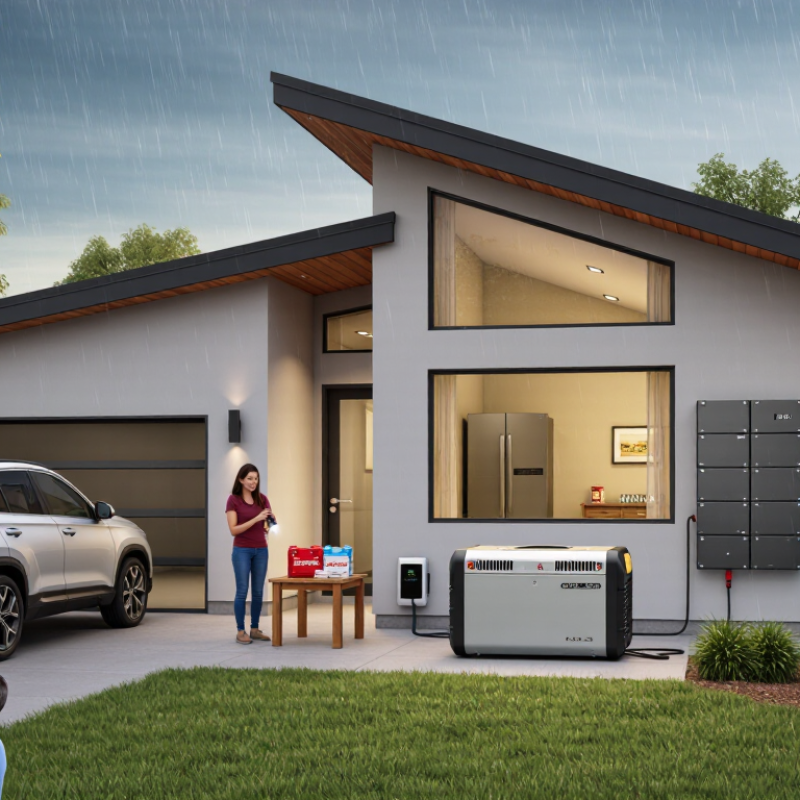
Measure Essential Loads Against EIA’s 899 kWh/Month U.S. Average
How to Choose the Best Backup Power for Home?
The U.S. Energy Information Administration reports average residential electricity use of 899 kWh per month. That equals roughly 30 kWh per day. However, this figure includes heating, cooling, cooking, laundry, and entertainment. A backup system rarely needs to support everything. Measure essential loads during an outage instead. Record each device’s running watts, operating hours, and starting surge. Refrigerators, sump pumps, and furnace blowers can demand brief startup power.
Make a simple load table. A refrigerator using 150 watts for eight hours needs about 1.2 kWh daily. A 750-watt sump pump running one hour needs another 0.75 kWh. Add lighting, internet equipment, medical devices, and phone charging. Keep a margin of 20% to 30%. Real homes are untidy. People open refrigerator doors, run extra lights, and misread appliance labels.
The U.S. Department of Energy recommends checking actual energy use before selecting efficiency or backup equipment. NREL’s U.S. Solar Photovoltaic System and Energy Storage Cost Benchmarks also separates usable storage from installed system capacity. That distinction matters. A 10 kWh battery may provide less usable energy after reserve limits and conversion losses. Size the inverter for continuous demand and motor-starting surges. Then compare the result with the EIA average, rather than copying it. My first estimate usually runs too low. Household habits change during storms. Measure again after one realistic outage simulation.
How to Choose the Best Backup Power for Home? - Measure Essential Loads Against EIA’s 899 kWh/Month U.S. Average
| Essential Load |
Typical Running Load
(W) |
Estimated Daily Runtime
(Hours) |
Estimated Daily Energy
(kWh) |
Estimated Monthly Energy
(kWh) |
Planning Starting Surge
(W) |
Backup Priority |
| Refrigerator |
100 |
10 |
1.00 |
30.0 |
600 |
High |
| Chest or Upright Freezer |
100 |
8 |
0.80 |
24.0 |
500 |
High |
| LED Lighting Circuit |
120 |
5 |
0.60 |
18.0 |
120 |
High |
| Internet Modem, Router and Network Equipment |
25 |
24 |
0.60 |
18.0 |
25 |
Medium |
| Sump Pump |
750 |
0.5 |
0.38 |
11.3 |
1,500 |
High |
| Private Well Pump |
750 |
0.25 |
0.19 |
5.6 |
2,000 |
High |
| CPAP or Similar Medical Device |
60 |
8 |
0.48 |
14.4 |
100 |
Critical |
| Laptop and Mobile-Device Charging |
100 |
3 |
0.30 |
9.0 |
100 |
Medium |
| Gas-Furnace Blower |
500 |
4 |
2.00 |
60.0 |
1,000 |
High |
| Total Essential-Load Estimate |
— |
— |
6.35 |
190.3 |
— |
Planning Total |
| EIA U.S. Residential Average Benchmark |
— |
— |
29.97 |
899.0 |
— |
Reference |
How to use this table: The listed essential loads represent approximately 190.3 kWh per 30-day month, or about 21.2% of the 899 kWh/month U.S. residential average cited from the U.S. Energy Information Administration. For a one-day outage, the estimated energy requirement is 6.35 kWh before conversion losses. A practical battery system should provide additional capacity for inverter losses, temperature effects, battery aging and unexpected runtime. The planning starting-surge values are representative sizing allowances; check the nameplate ratings of the actual appliances before selecting an inverter or generator. Central air conditioning, electric resistance heating, electric water heating, clothes dryers and electric vehicle charging are excluded because they can substantially increase power and energy requirements.
Size Battery Capacity for Runtime, Surge Demand, and 80% Usable Energy
How to Choose the Best Backup Power for Home?
Size Battery Capacity for Runtime, Surge Demand, and 80% Usable Energy
Choosing home backup power starts with honest load measurements. List each appliance, its running wattage, and its startup demand. A refrigerator may use 150 watts while running, yet briefly need 800 watts to start. Pumps and compressors often create similar surges.
Runtime depends on usable battery energy, not the advertised capacity. A 2,000 watt-hour battery provides about 1,600 watt-hours when limited to 80% discharge. If your essential devices average 400 watts, the theoretical runtime is four hours. In practice, inverter losses may reduce it to about three and a half hours. Keep some margin.
Measure real usage.
Add the startup wattage of devices that may operate together. A refrigerator, modem, lights, and medical equipment can exceed the inverter’s surge rating, even when their normal load seems modest. Avoid powering high-heat appliances unless the system is specifically designed for them. They drain batteries quickly.
In practical testing, a plug-in power meter reveals habits that labels miss. A freezer cycling overnight may consume less energy than expected, while an old pump can perform very differently. A neat spreadsheet can still mislead. Recheck loads during cold mornings, outages, and simultaneous appliance starts. Capacity should cover the required runtime, while the inverter must handle both continuous and surge demand.
How to Choose the Best Backup Power for Home?
Size battery capacity for runtime, surge demand, and 80% usable energy.
How to read the chart: The calculation assumes 80% of the nominal battery capacity is usable and 90% inverter efficiency. Estimated runtime is calculated as: usable energy × inverter efficiency ÷ continuous load.
A 1,024 Wh battery provides approximately 2.5 hours at a 300 W load or 0.9 hours at an 800 W load. A 4,096 Wh battery provides approximately 9.8 hours at 300 W or 3.7 hours at 800 W.
| Example load |
Typical running demand |
Possible startup demand |
| Refrigerator |
100–400 W |
600–1,200 W |
| Sump pump |
800–1,500 W |
1,500–3,000 W |
| Internet router and modem |
10–20 W |
Usually minimal |
Surge requirement: Choose an inverter whose continuous rating exceeds the combined running load and whose surge rating exceeds the highest startup demand of motor-driven appliances. Battery capacity determines runtime; inverter power determines whether the appliances can start and operate.
Compare Portable, Whole-Home, UPS, and Standby Generator Systems
Choosing backup power starts with the outage you actually face, not the largest system available.
The U.S. Department of Energy estimates that power interruptions cost the American economy up to $169 billion annually.
A portable power station suits short outages, phones, lights, routers, and medical equipment. It is quiet and movable, but its battery may not support heating or well pumps for long. Keep it outside. That advice does not apply to battery units, but the room still needs ventilation.
A UPS is more specialized. It protects computers, networking equipment, and sensitive electronics from brief interruptions and voltage changes. Its battery usually lasts minutes, not hours. That gap matters.
A whole-home battery system can run selected circuits, or nearly the entire house, depending on capacity and installation. The National Renewable Energy Laboratory notes that storage sizing depends heavily on load profiles, duration, and local solar conditions. A first estimate can be wrong.
A standby generator starts automatically after grid failure and can support heavy loads, including pumps and heating systems. It needs fuel, periodic testing, safe exhaust clearance, and professional installation.
Portable generators cost less, but they require manual setup and must remain outdoors, away from doors and windows, as advised by the Consumer Product Safety Commission. The right comparison is not only runtime. Consider transfer speed, noise, maintenance, fuel availability, critical circuits, and local weather risk. No option is perfect.
Verify Inverter Ratings and UL 1741 and IEEE 1547 Compliance
How to Choose the Best Backup Power for Home?
Choosing home backup power starts with the inverter, not the battery size alone. Check its continuous output, surge rating, voltage range, and efficiency under realistic loads. A refrigerator may need extra starting power, while a sump pump can run for several minutes at high demand. Do not rely only on the largest number printed on the enclosure. Look beyond the label.
For grid-connected systems, verify documented compliance with UL 1741 and IEEE 1547. UL 1741 evaluates inverter, converter, and controller safety, including protection and performance requirements. IEEE 1547 addresses how distributed energy resources interact with the utility grid. It covers voltage, frequency, anti-islanding, and reconnection behavior. Ask for current certificates, test reports, and the exact model number. A sales sheet is not enough.
Local approval still matters. Confirm that the equipment suits your utility’s interconnection rules and local electrical requirements. An experienced installer should explain transfer equipment, grounding, disconnects, and battery isolation in plain language. Check whether the inverter supports the loads you actually use, not an imagined emergency setup. A small mistake here can leave lights working while the heating system stays off. I would also recheck every rating after installation, because field wiring, temperature, and battery voltage can change performance. Even careful planning has weak spots. That is where documented testing and professional inspection become valuable.
Confirm Installation Safety Under NFPA 855 and NEC Article 706
How to Choose the Best Backup Power for Home?
Home backup power should begin with installation safety, not battery capacity. The U.S. Energy Information Administration reported about 5.5 hours of average customer interruptions in 2022, including major events. That figure shows why resilience matters, but a larger system is not automatically safer. NFPA 855 addresses stationary energy storage, including location, separation, fire detection, ventilation, and emergency response planning. NEC Article 706 covers electrical installation details, such as disconnects, overcurrent protection, wiring, grounding, and required labels. Use the edition adopted by your local authority having jurisdiction. Standards can differ locally.
A safe installation needs a documented load calculation and a clear shutdown method. Keep equipment away from doors, sleeping areas, combustible storage, and damp locations. The installer should verify conductor sizing, fault-current ratings, battery clearances, and transfer equipment. UL Solutions’ battery safety research consistently emphasizes testing, thermal management, and installation controls. Still, certification alone does not fix poor placement. I have seen plans that looked complete but ignored maintenance access. That mistake deserves a second review.
Tips:
Ask for a permit pathway before purchasing equipment. Request a one-line diagram and an emergency shutoff label. Confirm whether NFPA 855 and NEC 706 are both referenced locally. Have the final installation inspected by the authority having jurisdiction. Keep records of commissioning, firmware updates, ventilation checks, and battery inspections. Do not store gasoline, paint, or cardboard beside the system. Safety paperwork is useful, but physical access matters more.