2026 Best NBPT Fertilizer Suppliers for Global Buyers
Choosing among the 2026 Best NBPT Fertilizer Suppliers for Global Buyers requires more than comparing prices. Nbpt Fertilizer can reduce nitrogen losses when applied under suitable soil, weather, and crop conditions. However, performance depends on formulation quality, active ingredient content, coating consistency, storage stability, and field management. A low-cost product may become expensive if it arrives degraded or performs unevenly.
Dr. Tom Bruulsema, a respected nutrient-management specialist, summarizes the guiding principle: “Right source, right rate, right time, right place.” This principle matters when evaluating international Nbpt Fertilizer suppliers. Buyers should examine laboratory certificates, batch traceability, product specifications, technical support, and export experience. Packaging also deserves attention. Moisture-proof bags, clear labels, and stable warehouse conditions can protect product quality during long transport.
Reliable suppliers should explain hydrolysis inhibition data without exaggerated promises. They should also provide practical application guidance for urea, soil type, temperature, and rainfall patterns. Some claims may sound impressive. They still require independent verification.
This guide compares suppliers through a buyer’s practical lens. It considers production capacity, quality control, documentation, delivery reliability, and technical communication. Regional availability matters too, because shipping delays can disturb planting schedules. No supplier is perfect. Even strong manufacturers may face seasonal pressure, changing freight costs, or inconsistent local support. Buyers should reflect on those risks before signing large contracts. The best choice is not simply the largest producer. It is the supplier that offers dependable Nbpt Fertilizer, transparent evidence, and support suited to real field conditions.
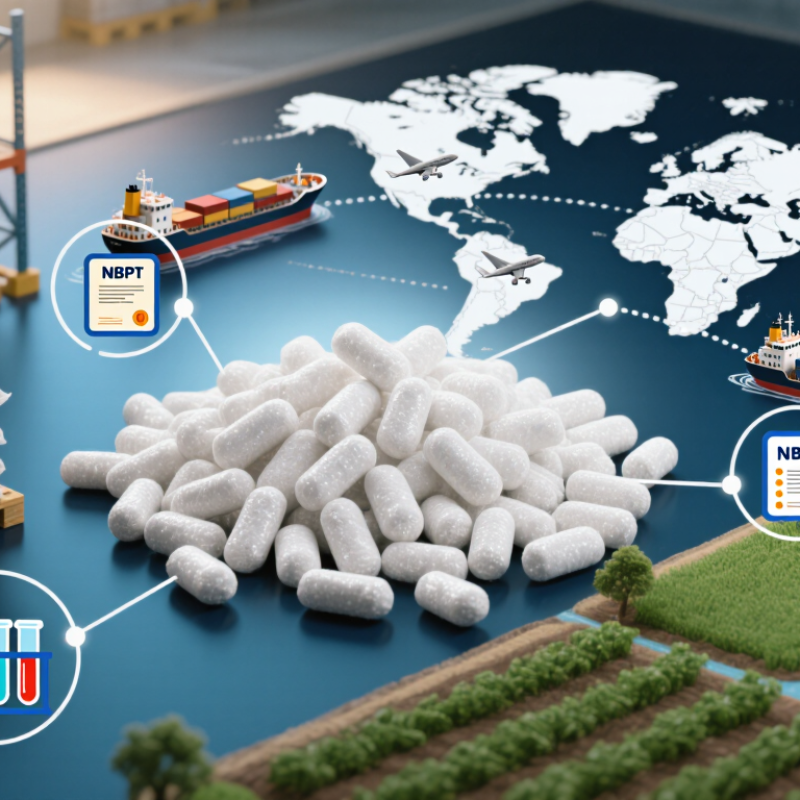
NBPT Fundamentals: CAS 94317-64-3, Purity Grades, and Urease Inhibition
NBPT, or N-(n-butyl) thiophosphoric triamide, carries CAS 94317-64-3. It is widely used to slow urease activity in urea fertilizers. This delay keeps more nitrogen available for crop uptake. Field research reviewed by Cantarella and colleagues reported ammonia-loss reductions commonly ranging from 30% to 70%. Results changed with soil moisture, temperature, wind, and application method.
Field reality differs.
Commercial NBPT is often offered in 95%, 97%, or 98% assay grades. These figures require careful interpretation. Buyers should verify the testing method, moisture, appearance, storage stability, and certificate-of-analysis consistency. A 98% assay can still underperform if the material degrades during transport or mixes poorly with urea. Purity alone is not enough. IFA’s 2024 Medium-Term Fertilizer Outlook projects global nitrogen demand growth of roughly 1% annually through 2028, supporting continued interest in urease inhibitors. Procurement teams should compare active-content results, not only quoted prices. Practical checks include sealed packaging, batch traceability, HPLC results, and accelerated-stability data. I would also request compatibility tests with the intended urea formulation, because laboratory performance may not fully predict field behavior.
Nitrogen-Loss Context: Urea Volatilization Can Reach 10–40% Without NBPT
2026 Best NBPT Fertilizer Suppliers for Global Buyers
Nitrogen-Loss Context: Urea Volatilization Can Reach 10–40% Without NBPT
Urea can lose substantial nitrogen through ammonia volatilization after surface application. Under warm, dry, alkaline conditions, losses may reach 10–40% without NBPT. The actual figure depends on soil pH, moisture, wind, residue cover, and rainfall timing. It is not a fixed number.
NBPT slows urease activity and gives rainfall or irrigation more time to move urea into the soil. In practical field work, application timing matters as much as product selection. A dry urea granule on crop residue behaves differently from granules incorporated into moist soil. Small differences can affect crop color, early growth, and later nitrogen demand.
Global buyers should request batch specifications, active-content testing, storage guidance, and independent quality records. A reliable supplier should explain expected performance across temperatures and application methods. Packaging also deserves attention. Moisture exposure can reduce product consistency during long-distance transport. Ask for traceability from production to delivery.
Field results still need careful interpretation. NBPT is not a guarantee against every nitrogen loss pathway. Heavy rain, poor placement, and incorrect rates can reduce its value. Some recommendations look convincing on paper but perform unevenly across regions. That is why local trials, clear documentation, and realistic agronomic advice remain essential.
2026 Supplier Qualification: Verify ≥95% Assay, COA, REACH, and ISO 9001
2026 Best NBPT Fertilizer Suppliers for Global Buyers
Supplier qualification should begin with evidence, not sales claims. A minimum 95% NBPT assay is useful, but the test method matters. Request a recent COA showing assay, moisture, appearance, batch number, production date, and laboratory signature. Match the COA with a retained sample. Then use an independent laboratory for confirmation. Small differences can affect field performance.
Demand is becoming less forgiving. The International Fertilizer Association’s Medium-Term Fertilizer Outlook 2024–2028 projects global fertilizer demand to approach 205 million tonnes of nutrients by 2028. This growth increases pressure on quality control and delivery reliability. Buyers should audit batch consistency, packaging seals, storage conditions, and complaint records. A supplier with ISO 9001 certification should provide a valid certificate, issuing body, scope, and site address. The ISO Survey 2023 recorded more than 1.2 million ISO 9001 certificates worldwide, so certification alone proves little.
REACH verification needs careful wording. Ask whether the substance is registered, exempt, or covered through an applicable downstream arrangement for your market and tonnage. Request the registration or inquiry reference where legally available, plus the latest safety data sheet. Do not accept a generic compliance statement. Check identity, impurity limits, and classification against the supplied product. I have seen paperwork look complete while the batch details did not match. That is a warning. A practical supplier file should contain the COA, independent test report, REACH documentation, ISO 9001 certificate, SDS, traceability records, and corrective-action history.
Performance Comparison: NH₃ Reduction, Application Rates, and Yield Response
For global buyers, the best NBPT fertilizer supplier is not defined by price alone. Performance depends on concentration, formulation stability, and field support. Urease inhibitors can reduce ammonia loss from surface-applied urea, but results vary widely. Warm weather, alkaline soil, wind, and delayed rainfall may increase volatilization.
Compare suppliers using measured NH₃ reduction, not promotional claims. Independent field trials often report reductions from 30% to over 70%, depending on conditions. Ask for test methods, soil details, weather records, and untreated controls. Application rates also need careful comparison. A common benchmark is 0.05–0.10% active NBPT by urea weight, but the correct rate depends on formulation and exposure risk. More product is not always better.
Yield response is usually modest when nitrogen losses are already low. It can become meaningful where urea remains exposed for several days. Look for replicated trials showing grain yield, nitrogen-use efficiency, and crop safety. One limitation deserves attention: many supplier trials use ideal management. Real farms are less predictable.
Tips: Request batch certificates and storage data. Confirm compatibility with coating equipment. Test a small field area first. Record rainfall timing and crop response. A practical supplier should discuss failures, not only successful plots. Supplier quality also includes consistent particle coating and responsive technical support.
Global Procurement Review: Capacity, Lead Time, Incoterms, and Landed Cost
Global buyers should judge NBPT suppliers by delivered performance, not factory output alone. The International Fertilizer Association’s 2024 medium-term outlook places global fertilizer demand near 201 million tonnes of nutrients in 2023/24. That scale supports demand, but it does not prove NBPT availability. Ask for audited monthly capacity, recent batch records, assay results, and a realistic allocation plan. Nameplate capacity can look impressive. Actual output may be seasonal.
For lead time, separate production, port handling, ocean transit, and customs clearance. A serious 2026 quotation should show each segment in days. UNCTAD’s Review of Maritime Transport 2024 documents how rerouting and port disruption can extend voyages and increase freight exposure. I would request standard and disruption-adjusted shipping scenarios. Twenty-five days may become forty. Incoterms also change risk. Under FOB, the buyer controls freight after loading. Under CIF, the seller arranges freight, but destination charges still require checking.
Calculate landed cost per metric ton, including product price, freight, insurance, duties, terminal handling, finance, testing, and inland delivery. The World Bank’s 2023 Logistics Performance Index shows wide gaps in customs and infrastructure efficiency across markets. Do not compare CIF offers alone. A cheaper cargo can lose its advantage through demurrage or slow clearance. One weakness remains: forecasted lead times are rarely guaranteed. Require a written validity period, shipment tolerance, and remedy for delays. A spreadsheet helps, but it can still hide operational risk.
